Sunday, October 30, 2011

Accessing the Right California Resources

The first resource that I decided to research was James J. Rawls’s “California: A people, a Place, a Dream”. This article discusses the false hope that California promises immigrants that migrate to the dreamland. James J. Rawls states that the California Dream is filled with high expectations that are not met once immigrants get here. California is seen as a place of “endless blue skies and spectacular seacoasts” (Rawls 142). Many people believe that their deepest longing for a better lifestyle will be fulfilled once they arrive to California. However, many immigrants are surely mistaken once they arrive to the “Golden State” and realize that the California Dream is simply a myth. Rawls traces the origin of the false California Dream all the way back to the Gold Rush where a mass influx of eager and expectant people, who believed that no work was required to fulfill their dreams, filled the state of California. These people created the false California Dream that, still to this day, lead immigrants to believing in the false hope that California provides. This article is extremely helpful in the fact that it allows me to get an even better grasp as to what immigrants thought of California before migrating there and how they viewed it afterwards.


The second resource that I explored was “Immigrants Out!: The New Nativism and the Anti-Immigrant Impulse in the United States”. This article focuses on the America’s view of immigrant in the country and even focuses on California's Proposition 187, which was a proposition to establish a state-run citizenship screening system as well as prohibit illegal immigrants from using health care, public education, and other social services in California. This article will definitely be useful in figuring out whether California accepted the assimilation of certain groups of immigrants. Identifying key figuring such as intermarriage between ethnic groups is the ultimate measuring stick as to whether or not a group has truly assimilated in America. This along with many of topics concerning immigration is viewed in “Immigration Out”.

Monday, October 24, 2011

Storytelling

On Wednesday October 19,2011 I witnessed Tracey Kidder, a Harvard University graduate, deliver a captivating speech about his time in Africa and his experience with a friend that changed his life. Kidder begins his storytelling with an anecdote about his soon-to-be friend Dei, who endured pain and strife in the midst of civil unrest in his country of Burundi. Dei eventually escaped to America where he enrolled in Columbia University. Immediately, the idea of sunshine and noir hit me as I imagined the war that proceeded in Burundi represented darkness and confusion (noir) while the hope and promise that America provided represented light and positiveness (sunshine).
Later Kidder discusses how he met Dei and traveled back to Burundi in order help with the poverty that consumed the area. Dei had the mindset of creating something bigger than himself upon his arrival and so he did as he constructed the "Village Health Works". This structure was a hospital that aided the sick and wounded in Burundi. Dei's mindset was completely different from the mindsets of the water barons of Los Angeles such as William Mulholland because, in contrast to Dei, Mulholland only cared about getting water into Los Angeles and not the lives of the people of the Owens River Valley.


Kidder closed his speech with the main point of his speech which was, "one can understand the world through storytelling". He proceeded to elaborate by stating that storytelling is an art that if used right can captivate an entire audience. This reminded me of the reason why students at USC are required to take Writing-140. This class is meant to develop student's ability to create arguments and back them up in order to convince your audience of your position.

Friday, October 21, 2011

William Mulholland Revealed!

After deeply researching the famous water engineer of Los Angeles, William Mulholland, my opinion of his character and morals has largely changed. Initially, my view of Mulholland was skewed due to the viewing of the movie "Cadillac Desert". The movie contained heavy commentary from Mulholland's granddaughter. At one instance of the movie she talked about Mulholland being only concerned about the people of Los Angeles when the St. Francis Dam broke. Her kind, warming words about her grandfather throughout the film planted an image of a compassionate, noble man inside my head. This image would begin to germinate in my psyche and before you know it my draft of my "LA's Past and Prologue" essay is geared toward Mulholland being the kind savior of Los Angeles. However, my research has led me to conclude that Mulholland was not concerned with the people of LA or the people in which he took the water from.


Mulholland was a water engineer, and with an engineer's mindset, he saw the task of getting a water source for LA with tunnel vision. This means that Mulholland created a solution that did not keep in mind the side effects that it would create. The solution was an extensive aqueduct that carried water from Mono Lake and Owens River Valley to LA, but this masterpiece did not take into account the damage of the ecosystem of the two water sources. In addition, the people of Mono Lake and Owens River Valley lost the majority of their source of water for their own needs. The caring image of Mulholland in "Cadillac Desert" was created by his granddaughter, a close relative who was likely to supply this view of Mulholland. Real history shows that this water engineer was not concerned with anything but getting water into the growing city of Los Angeles.


With this being said, the citizens of Los Angeles are also to blame for the deprivation of water from the Mono Lake and Owens Valley Lake community. The people of LA as a whole were only concerned with getting water into the city as well, and did not care about the methods that transported the resource into it. This is evident because no protests or disapprovals were made about Mulholland until after the St. Francis Dam broke. Los Angeles at that time period was only concerned with growth and expansion, and not the well-being of other cities and regions.


Monday, October 3, 2011

William Mulholland-Savior or Foe?

For my topic on the history of Los Angeles, I decided to write about the water struggle in LA and the man, by the name of William Mulholland, who constructed the water aqueducts that allowed for water to flow through the regoin. At the beginning of the acquisition of water to LA, Mulholland was seen as the hero of the city. Los Angeles was growing and without adequate water supply the city would stop growing. As a result, Mulholland had the idea of bringing water to LA via the Owens River Valley. He would do this by building aqueducts from the River Valley to Los Angeles in what became the key factor to Los Angeles expanding to the size it did today. After the project was completed, Mulholland was treated as if he were a God as the whole idea of LA being a beautiful paradise was now complete due to the availability of water. However, the notion of William Mulholland being the savior of LA completely diminished when a dam holding the city's water reserves breaks after inspection. This devastating event cost millions of dollars and numerous lives. Mulholland was immediately shunned from the town and fell out of the grace of Los Angeles forever. In my research, I will be looking articles and documents that discribe how the citizens of LA felt toward Mulholland on a deeper level after the breaking of the dam. The more detail I aquire on the feel of the citizens of LA during the tragic event, the better understanding of the spirit and nature of LA I acquire.

Monday, September 26, 2011

Diversity Welcomed!

The Hollywood Walk of Fame is one of the most recognized public spaces in California. This is where all the celebrities come out to promote their movies, sign autographs, and interact with their fans. So what purpose does this serve to LA might you ask? Well, the admiration of the celebrity lifestyle is cherished by all people from unique walks of life. At the Hollywood Walk of Fame, people from different races, classes, and background meet to enjoy the celebrity lifestyle for a day.

This is a diverse space that LA despirately needs because throughout the city is nothing but seperation and segretation. With the Hollywood Walk of Fame, united diversity is the "norm".

Wednesday, September 21, 2011

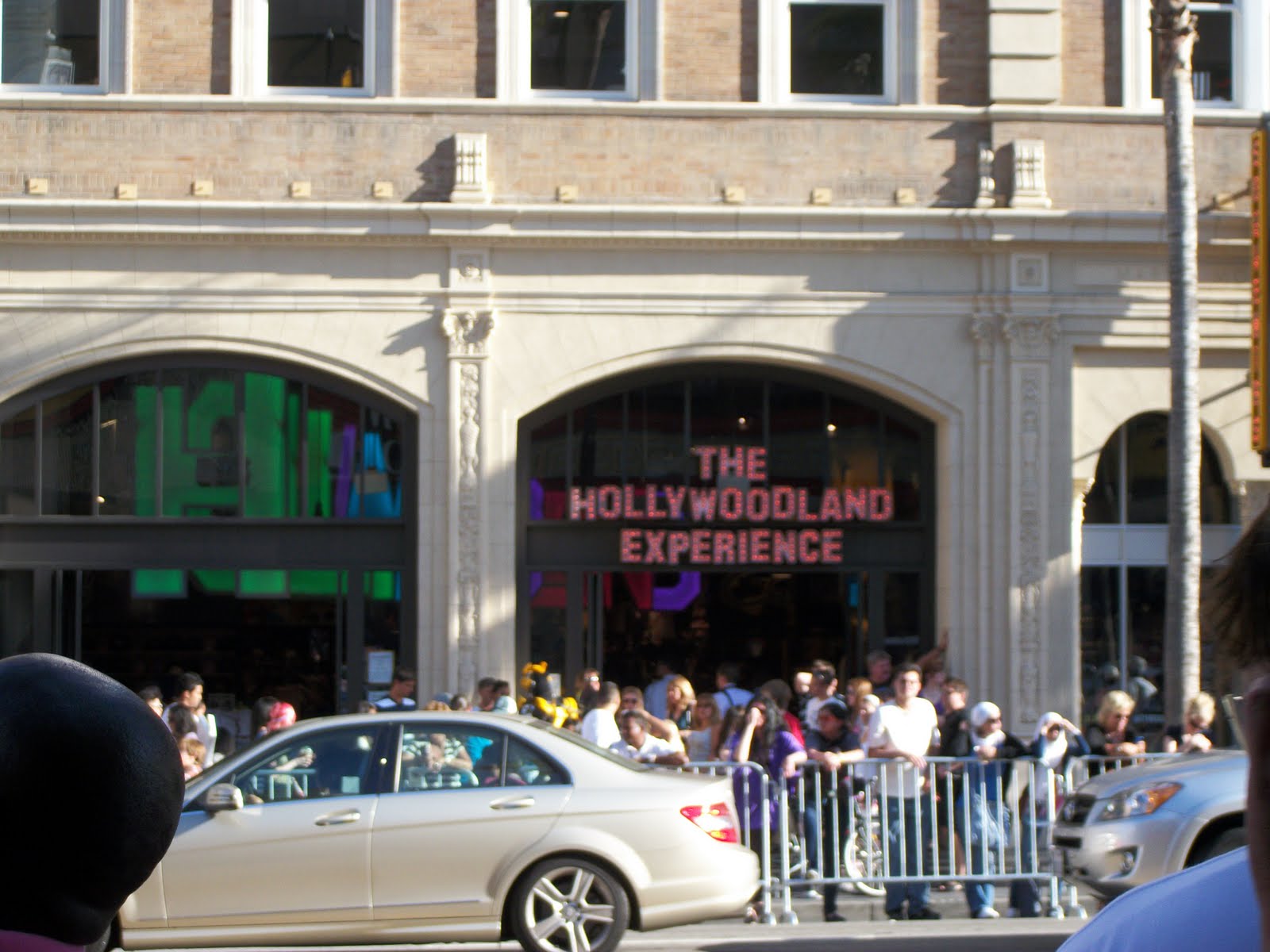
Walking on Fame-The Hollywood Experience

As a foreigner of The Golden State, I chose to observe Hollywood, California as my public place. The unique culture and excitement of this space has always been depicted in the media as the cliché movie town. Although it is the movie capital of the world, Hollywood brings together all kinds of people from all different walks of life into one area. There is truly no other place like this in the world.


Upon arriving in Hollywood, all five of my senses kicked in like never before. The atmosphere was simple electric, and the streets were jammed-packed as I attempted to make my way through the crowd. I began to believe that my eyes were deceiving me because the streets were filled with people dressed in vivid superhero costumes, wild Lady Gaga attire, and even skimpy lingerie. It was mind blowing to say the least. With everything around me moving so fast, I peered down at the ground to see aligned stars filling up the walkway. These stars represent famous celebrities who have contributed in a way to their area of success. I started looking down the majority of my time in Hollywood as I saw the stars of Tom Cruise, Ray Charles, and Marilyn Monroe.


This hectic scene only showed signs of increasing as the day moved on. There was a movie premiere down the block and all the tourists lined up quickly to watch the stars get out their limousine and get interviewed. Before standing in line for the premiere, I decided to view all the stores that sat on the Hollywood Walk of Fame. All the shops there had a unique concept to them but they all catered to tourists wanting to take Hollywood back home with them. I ended up buying a mug, keychain, and poster for my family back home.
The movie premiere was my last treat for the day and it was quite the treat. Jamie Foxx premiered his latest movie to those in attendance and the crowd went crazy. Camera flashes nearly blinded me as the crowd took pictures of Jamie hopping out his sleek limousine headed toward the Nokia Theater. This place called Hollywood is an amazing scene that I believe everyone should experience once.

Wednesday, September 7, 2011

Immunity To Drugs

After planning and drafting my paper for a little over a week now, I have garnered even more insight from Jay-Z's "Hollywood" as I found myself looking at this tainted town through his eyes. In his song he raps, "Born in Brooklyn got a place in Manhattan, going back to Brooklyn to escape the madness. When your friends is Chris and Gwyneth, when your girl is more famous then you then is". This line opened my eyes and made me realize that not all celebrities are brainwashed by the Hollywood lifestyle that they are submerged in. Stars like Jay-Z often leaves this world to go back to the place where he can get a peace of mind. This peace of mind allows him to function with a leveled head and not become morphed into a vain shell of himself. This leads me to believe that some are simply immune to this drug called Hollywood. The California Dream, which consists of relaxation and no worries, that leads hopefuls to the town of Hollywood does not affect only a small portion of people. These people are able to block of the addictive aspects of the Hollywood lifestyle and make decisions that will benefit them in the long run.